
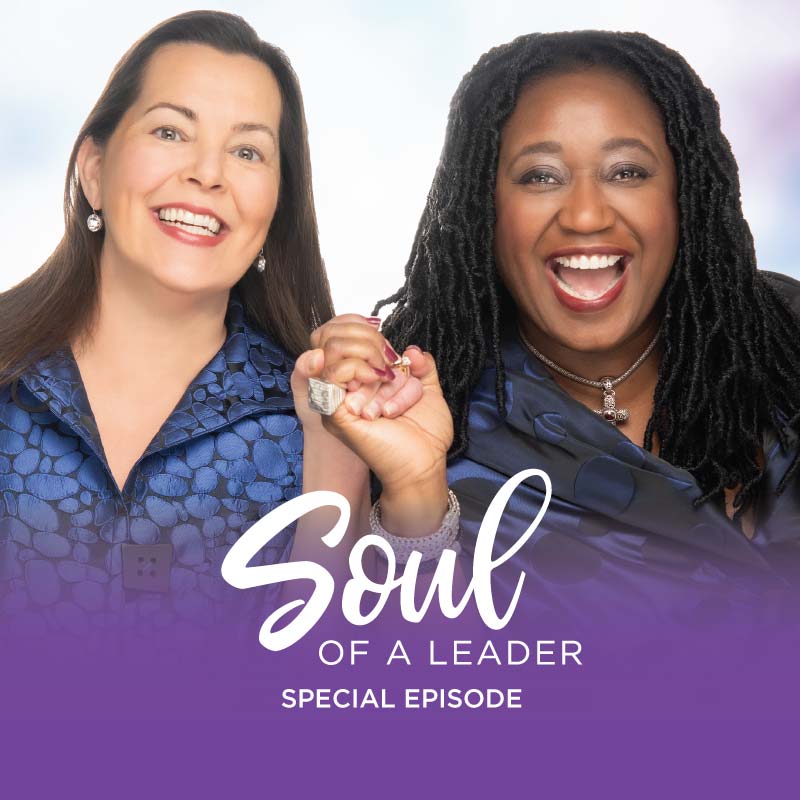
SOAL 11: Special Episode
subscribe
Join in this special episode where Dr. Alicia and Dr. Eileen sit down together and have a very intimate and candid conversation on the current world issue of systemic racism and the black culture.
After the tragic killing of George Floyd, our world has been turned upside down with devastation and unrest. During this engaging dialogue, we ask ourselves how do we help one another and understand one another?
Dr. Alicia and Dr. Eileen discuss with us their shared core values to making a positive change within ourselves and showing love and compassion to all humankind.
Every one of us has a sphere of influence, how can we as a generation pay it forward and heal the wounded with love?
Wisdom is gained in the silence.
You’ll Learn
- The soul doesn’t see color, disabilities, or judging.
- There are several core values to live by; wisdom/learning, self-control/self-discipline, truth, courage/justice, listening, and communication.
- Life is about turning back and paying it forward for the blessings and gratitude you have.
- Lead with compassion, listen with empathy.
- Ask God for wisdom.
Resources
Eileen Timmins | LinkedIn
Alicia Straughter | LinkedIn
Transcript
Alicia Straughter:
Welcome to Soul of a Leader Special Episode from Dr. Eileen and Dr. Alicia. We are here to bring out our thoughts on the current state of African American culture, black culture, leadership, and really what some strategies of thought process as we are long time executives in the HR industry. We can definitely, from our conversation today, bring some type of structure or content to what we see could be a healing process, a process of strategy that will give positive outcomes, some short-term, as well as possibly some long-term plans and processes from an HR perspective.
Alicia Straughter:
Really our thought process is to get people to think more about how do we need to love one another? How do we need to just respect one another and not be judged by the color of our skin? So that’s why we wanted to have a special episode to just have our own personal dialogue, I guess.
Eileen Timmins:
Well, and thank you so much, Dr. Alicia. That was a wonderful summary of what we’re trying to do. Here at Soul of a Leader, we believe that the soul gives life to the body. We also see the world with the eyes of the soul and the soul has no color. It’s about energy.
Alicia Straughter:
Absolutely.
Eileen Timmins:
The soul doesn’t see color, disabilities, judging. It’s just pure energy, and that’s what we’re all here about. There’s a quote by Dr. Martin Luther King that he says, “I have a dream that one day my children and all children,” he had said at one other day, “will live in a nation where they will not be judged by the color of their skin, but the content of their character.” How many of you listening just want to be judged by the content of your character or your values and be loved?
Alicia Straughter:
Yes.
Eileen Timmins:
Each one of us on this earth just wants to be here to be loved, go home to our family, walk down the street, just be love and shine love. That’s what humankind is about and human beings.
Alicia Straughter:
Yes. I like the quote from Dr. Martin Luther King. We want to be judged by the character, our character, not by our skin tone. And to help bring that out a little more: God made one race. God made one race, and that is the human race. So for me as a black woman, a woman of color, African American, whatever the title people describe me as, I know how it feels to be judged just by the way I look.
Alicia Straughter:
I know how it feels to work in an environment where you see the blatant racism. I know how it feels to go into a store or into … And I’ll give an example. It was a couple of years ago. I went to the car dealership and I won’t say the name because it’s a very big brand. So as long as you own that car, you can get a free car wash.
Alicia Straughter:
I had had the car for 15 years, 12, 15 years, so I was getting the car washed. It happened to me early on when I got the car wash. I was in the line, you just drive up. I see this young gentleman, a white kid in his teens, summer job, you could tell was hot. He’s nice to everyone as they were getting out of their car and getting out.
Alicia Straughter:
Of course, everybody in front of me was white. By the time he got to me, he looked down at my plates. He said I couldn’t get a car wash because I didn’t buy the car here. I said, “Hmm. Excuse me?”
Alicia Straughter:
“You can’t get a car wash because you didn’t buy the car here.” I said, “What does it say on my car? It’s a Lexus, right? And as long as I own a Lexus, I can come here to get a carwash.”
Alicia Straughter:
So he proceeded to give me the little ringer or bell, whatever that little gadget was. On the inside, I started to feel myself fuming and I start pacing. I said, “Do I say something or do I not say something?” I paced for a moment, and I said, “No, I’m going up here to say something because I have owned this car for almost 15 years. So every repair that I’ve done, they had my money in the system to say how much money I spent in Lexus dealerships.”
Alicia Straughter:
So I immediately asked for the supervisor and I said, “I want the supervisor up here right now.” Then when I told him what happened, then of course the GM came and I explained to him. I tried to stay as calm as I could, but obviously when you feel the discrimination, when racism is right in your face, words cannot explain how you really feel at that moment.
Alicia Straughter:
They all got it. They apologized. They all call me. And I said, “Listen, I don’t know who he is, but he doesn’t treat me that way ever again when I’ve spent thousands.” I said, “Look me up. I spent thousands in this dealership, thousands. A free car wash and you treated everybody better and they were all white. I have to say it. And when you got to me, his whole demeanor had changed.” The guy said he took his job too … He obviously did take his job too seriously. Obviously, I knew he did.
Alicia Straughter:
But that’s where it starts. It starts there when we see it. And so it hurts us when people say racism doesn’t exist. Because it doesn’t happen to you does not mean it does not exist. It hurts us when people say, “Well, I don’t see what’s all the fuss about.” Well, if you have a Coca-Cola bottle or if you have a juice or something like acid and you shake it up and you just shake it up and you just shake it up and you shake it up. When you take the top off, what happens? Well, it explodes.
Alicia Straughter:
For me and others in our culture, the explosion happened with George Floyd’s death. It was traumatizing for us to visualize that. I think that’s the most traumatizing part. We all black, white, Indians, whoever, we all witnessed a killing, a murder.
Alicia Straughter:
So we want to share on this episode from our perspective and both Dr. Eileen and I have experienced, but we have to learn. And one of the values that we share with our clients, we have to learn people. We have to learn to understand people. We have to learn to respect people, regardless of the color of a person’s skin. Learn who the person is first.
Alicia Straughter:
I think that quote from Dr. Martin Luther King is saying judge me for my character first, not how I look on the outside. So don’t judge our culture first, just because we are all dark-skinned. We’re just dark-skinned people, whether we’re brown, beige, [inaudible 00:10:19]. It’s just color. It’s a color. And it’s a color that God, again, He created the human race. It’s the color that he created.
Alicia Straughter:
I didn’t ask to be black. I didn’t. Eileen didn’t ask to be white. We just, this is what God chose for us. So I see for us in having this … and we want our conversation today to be very candid and open because it is time to discuss it. But not just discussing it. It’s we want to feel like we want to add value to the discussion and from our expertise and from an HR’s. How do we help, and how do we drive better learning ability from our listeners? It’s our experiences.
Alicia Straughter:
See, that experience, even though it’s three, four years ago, it was almost like it just happened to me. Whether people like it or not, it never leaves us. That’s just not the one; I have many. You could ask any black person. We all have a story or an experience that is never going to go away from us. That is never going to be silent.
Alicia Straughter:
It always leaves us wondering: Well, why? Why you have to be like that? We certainly not being racist to any other race that I know of. I mean, I’m not. I mean, I don’t know. I know I do my part to try to learn who people are and accept people for face value until they show me otherwise.
Eileen Timmins:
Thank you, Dr. Alicia, for sharing that very personal story that is so impactful.
Alicia Straughter:
I didn’t really know I was going to go on like that.
Eileen Timmins:
People need to hear the stories, right?
Alicia Straughter:
Yes, yes.
Eileen Timmins:
Because stories are the connection between the heart and the head.
Alicia Straughter:
Yes.
Eileen Timmins:
And with that, what you’re talking about goes back to what the core of each of us are.
Alicia Straughter:
Yes.
Eileen Timmins:
Pope Francis said, “Who am I to judge?” Right?
Alicia Straughter:
Yes.
Eileen Timmins:
Very holy man. And character values; each one of us is born and then we are formed with the values and some pillar of values. Just because you were formed or educated in a certain way when you were younger, doesn’t mean you can change it. Because once you’re an adult, you act like an adult. Once you’re a child, you act like a child.
Eileen Timmins:
There are four core values that I see align with this, that help. We have to learn first and by you telling the stories, it’s learning. We have to read and educate ourselves and we have to do and be. But the four pillars that I talk about are wisdom and by learning and hearing stories and experiencing it, you’re able to do that.
Eileen Timmins:
Second is self-control and self-discipline, right?
Alicia Straughter:
Yes. Yes.
Eileen Timmins:
The third is the truth, as you see it, right?
Alicia Straughter:
Absolutely. The truth.
Eileen Timmins:
The truth for me maybe a lot different internally than what the truth is for you. But the truth inside of us is what we see and perceive.
Alicia Straughter:
Yes.
Eileen Timmins:
Then courage and lastly justice, because if we don’t have the power of using our privilege or our success to support people with less privilege and less success, what are we here for humankind?
Alicia Straughter:
Absolutely.
Eileen Timmins:
Because as we go up and we succeed in our career, no matter what race you are, life is about turning back and paying it forward for the blessings and gratitude you have.
Alicia Straughter:
Yes. Yes.
Eileen Timmins:
That’s what my pillars are. Dr. Alicia, what values do you have? Because we go through these values cards. We sell them and we believe that values are so important to leadership, humankind. And that is the core of what the soul of a leader eyes is the value. So tell me. I shared with you, Dr. Alicia, my few. What about you?
Alicia Straughter:
I have four too, and for you and me, people have to know this, we have been friends for a very, very long time, years. We don’t want to tell our age, but it’s been back since grad school at Loyola.
Eileen Timmins:
It’s a very, very long time. We look younger than we are.
Alicia Straughter:
Yes, yes. It’s called the blessing of God in our lives. So when I think about those four pillars, one I mentioned a second ago, it’s learned. You have to always be in a state of learning. When I use the value cards that we have, and we do sell those, when I use them with our clients, I also use it for myself.
Alicia Straughter:
Listen is one of them. And when I say, listen, I want to say you could hear a person, but you can not be listening. So for me, that’s two different things. I think you have to listen to people, listen to hear. You got to listen with empathy and listen to hear what they really are saying.
Alicia Straughter:
One of the points you brought out is the truth. See, that could be their truth because that’s how they’re feeling or that was that experience. I call it through our research and when we were in Ph.D. that “lived experience.” You cannot take away that. So you have to listen with understanding and with empathy. And then listen with the goal in mind to how do I help?
Alicia Straughter:
Like you say, we have to reach back. I think for both of us, we’ve done so so long, we’ve always been helping if it’s not one another, it’s other people. But that comes naturally. So I think when you’re listening to people, listen with those other constructs of saying sympathy … empathy, excuse me, really what are they saying that is their truth? And then how can I now find a way to help that individual? So that’s how I look at that one.
Alicia Straughter:
My other is communication. The most talked-about topic next to leadership is communication. How do we communicate with one another? Understand everyone. It’s that nonverbal communication and verbal communication. And to look at the person’s body language.
Alicia Straughter:
When something affects us, sometimes you could just look at the body language without even that person saying anything. Because when that person did that to me, my whole body language changed as I was proceeding to figure out what to do.
Alicia Straughter:
So I think it’s key to understand how communication can be viewed and how it can be used, and not only in a time of crisis, but in a time of leadership where you have to communicate properly. And properly mean it’s what you need to say and what you shouldn’t be saying, how you should be paying attention to the non-verbal communication from the person you’re speaking to.
Alicia Straughter:
If they’re telling you they were affected by an issue within the work environment that was racism to them, communicate it back: “Well, what was it? Explain to me what that is.” Because now you have to listen and you have to know what to say and how to say. So that’s communication.
Alicia Straughter:
In the last point of my four values, I added love for multiple reasons. But one, God is a God of love, point-blank, period. He is a God of love. And if we can love one another, the world will be a much better place. Now, and let me say this: Love is just respecting someone else. You can just love them that way. You don’t have to get along with everyone. You don’t have to eat dinner with everybody. You don’t have to see someone.
Alicia Straughter:
But showing some type of love for humankind is the ultimate thing that I think we need to consider doing more of. Love. And that’s probably the third most talked-about word under the leadership, communication, and love that I think as human beings, we don’t quite get it. Love is not love-making. Again, it is God who created love. Love.
Eileen Timmins:
And Dr. Alicia, C. S. Lewis, many, many, many philosophies have love and there are different phases of love.
Eileen Timmins:
But as I’ve shared with you, and I’ve shared on our Soul of a Leader before, this is a quote from a philosophy that just supports everything that Dr. Alicia’s saying. I think someday it is soon. I think Rumi has said, “The wound is where the light enters.”
Alicia Straughter:
Yes.
Eileen Timmins:
And I’m hoping that this light is love. The quote is from Pierre Teilhard de Chardin, a French philosopher, and a priest. He said, “Someday, after mastering the winds, the waves, the tides, and gravity, we shall harness for God the energies of love. And then for the second time in the history of the world, man will have discovered fire.” Now that is what Alicia’s talking about and you could hear it in her voice.
Eileen Timmins:
The fire of love. And love is not physical. It can be physical, can be mental, it’s emotional. It’s about the love for our brothers and sisters on this planet. It’s about the love for everybody. I’m hoping and I’m praying and so is Alicia, that this “someday” is now and that wound is going to be healed with love. Because with that, we have to move forward with some tangible results. It’s like putting a puzzle together.
Alicia Straughter:
Yes.
Eileen Timmins:
We can have a vision of how we want to see what the world is. We take that vision, we pull it apart and it’s like a puzzle. We’re going to have to try to put pieces in there that will work and maybe not work. How many of you have put a puzzle together and tried to force a piece in there and it doesn’t work? You pull it back out. Your perceptions were wrong to fit into that piece.
Alicia Straughter:
Correct? Yes.
Eileen Timmins:
Today is the day that we have a vision and everybody on this earth, a vision of how we all are human beings. And now we have to put that puzzle together.
Alicia Straughter:
I agree with you. It’s a puzzle piece when you look at it. If it doesn’t fit, let’s figure out what’s wrong.
Eileen Timmins:
Yes. And you know what? We might go down a path and we may not have it right. But then we’ll have to be resilient and we have to not judge and we have to bounce back and we have to try different things to make the world a better place, not for only us, but the generation behind us, their generation either.
Alicia Straughter:
Behind us, absolutely.
Eileen Timmins:
I can tell you, the young children in this world and the young adults can interact with the older people, all the different demographics in a generation. Because of those young children, when you were younger, you were just joy and love. How can we use their minds, ideas, and energy to project us to that “someday” in that quote?
Alicia Straughter:
Yeah. Yeah. And one of the other parts to what you were saying about when a puzzle piece doesn’t fit, and I said, “Well, then you look at and see what’s wrong.” I think one of the problems from my perspective is we know something was built because systems are built-in companies; you build systems. And what our clients, which are corporate and some nonprofit and municipality, systems are built by people. People.
Alicia Straughter:
So when something doesn’t fit, you just don’t throw it aside: “Oh, we just let it … ” No. You look at and find out why doesn’t it fit. What’s really the problem? How do we fix the problem? And so what has happened is that people have built systems that were already broken, but built by people with the perception of what they want systems to be. It’s just like, “We’ll just keep trying to put that puzzle piece into the system. Eventually, it may work.”
Alicia Straughter:
Well, it’s not working because the system was built wrong so that puzzle piece would never fit in there. When you building something that is going to be wrong, nothing would ever fit into it. If it’s built to not bring positive growth to something, then it’s not going to work. If it’s built to suppress if it’s built to devalue people if it’s built to cast certain groups out, or whether it’s women of color where this males [inaudible 00:00:25:56], if it’s built to continue to X them out, well, then we go back to the puzzle.
Alicia Straughter:
That piece would never fit. So you already knew what the puzzle was. You already knew what systems you put in place. And so you can’t put anything in there, because you already know that it wouldn’t ever fit because it was not built for it to fit. Just like the puzzle piece that you put. It was never built for you to use that particular piece into that puzzle.
Alicia Straughter:
So I think it’s our job, because a lot of communication videos in the last couple of weeks, and when you see young kids marching … I recall this young girl. She looked like she’s six. That girl, I mean, she was intense: “No peace, no justice.” I think she’s got a lot. She’s got a lot of fire in her and she’s got a lot of courage and you can see. But this is our generation. She’s coming up in our generation saying, “No justice, no peace; no justice, no peace.” It’s like what you said: let’s listen to our young people.
Eileen Timmins:
Mm-hmm (affirmative).
Alicia Straughter:
We cannot think that it’s okay to continue to build a system that was already broke, that was already put together for the pieces not to work for our generation behind us that think that they want to grow up into something that’s already not working. It’s impossible.
Eileen Timmins:
This is a quote from Pope Francis and it says, “To educate is to seek meaning in everything. It is to teach others to seek the meaning of things.”
Alicia Straughter:
Yes.
Eileen Timmins:
“This meaning means mixing the dreams of children and young people with the experience of adults and the elderly. This exchange must always take place or else there will be no humanity because there would be no roots, no history, no promise, no growth, no prophecies.” So mixing that …
Alicia Straughter:
Yes.
Eileen Timmins:
You know what? They have solutions. It goes back to your listening and communication. We don’t know it all. Just because I have a Ph.D., you have a PhD, we are always learning.
Alicia Straughter:
Always learning, yes.
Eileen Timmins:
And these young, brilliant, honest minds may have the idea to help with that someday in energy alone.
Eileen Timmins:
We’ve had a really good conversation here, Dr. Alicia.
Alicia Straughter:
Yes, it’s very good.
Eileen Timmins:
As we ask all our guests the same question, leave us some words of wisdom. So I’m going to ask you words of wisdom and then I have a few that I will leave. I hope our listeners feel what we have felt like a friendship for years.
Alicia Straughter:
Yes.
Eileen Timmins:
The love and blessings and gratitude and non-judging and support that human to human can do if they’re compassionate, in empathy and listen, all the pillars we talked about in the values.
Alicia Straughter:
Mm-hmm (affirmative).
Eileen Timmins:
So go ahead, Dr. Alicia.
Alicia Straughter:
Okay. I want to read a quote from Rosa Parks. It’s, “To bring about change, you must not be afraid to take the first step. We will fail when we fail to try.” I would say because one of your pillars was wisdom, God gives us wisdom. We should ask for wisdom from God. If each person takes the time to make the effort or the first step to making a change, that’s how change is going to happen.
Alicia Straughter:
I’m not trying to change the whole world. I’m just trying to change the things that I know I have access to, impact too, influence on, connections with. It starts by making the first step. I think we now are in a position of what has happened to not feel uncomfortable anymore. Because, again, if you’re uncomfortable, ask yourself why are you uncomfortable? Be honest.
Alicia Straughter:
There was a talk on SuperSoul Sunday with Oprah with a young man. And he said, “When was the last time you got naked? Not naked when you went to the shower or whatever you do when you get naked. But when was the last time you got naked?” I was listening intensely to what he was saying.
Alicia Straughter:
What he was saying is, when was the last time you looked in the mirror or you sat down and you ripped everything off you that you knew was not of good? Or you faced yourself and said, “I can do better”? Well, I notice my colleague dealing with something. Oh, I noticed my neighbor’s issue, or I know that what’s going on is wrong.
Alicia Straughter:
When was the last time you took the time to make the first step to be a part of the change, to want to see a better world? Not only if you have kids, but for your neighbor’s kids or for your nieces and nephews or anyone that is coming up the generation behind you. What impact can you leave on this earth to say at least I took the first step?
Eileen Timmins:
Thank you for sharing that, Dr. Alicia, because I was going to share that every one of us, every single one of us has a sphere of influence.
Alicia Straughter:
Yes.
Eileen Timmins:
And how we can use that sphere of influence to activate change for the better, for the good of humankind. So that was just a wellspring of knowledge that you shared.
Eileen Timmins:
I’m going to end with a few things of wisdom that I would like to share with our listeners about their sphere of influence and how they can move forward. Realize that you are going to lead with compassion and share with others how to do so. You will meet people where they are and watch them bloom with love and compassion.
Alicia Straughter:
Yes.
Eileen Timmins:
And forgiveness. You are going to use your voice for the positive, and you are going to direct your energy and emotions to the positive with love and become a wellspring of love. That is how we’re going to change the world.
Eileen Timmins:
I can’t thank you enough, Dr. Alicia, and you’re my good friend, on sharing this and us having this conversation.
Alicia Straughter:
Yes. Yeah.
Eileen Timmins:
Because I hope others who are friends of multi-races can begin these conversations.
Alicia Straughter:
Yes.
Eileen Timmins:
If you come to the table with love and compassion for each other, the conversation will not be awkward.
Alicia Straughter:
Absolutely.
Eileen Timmins:
That’s what we’ve done.
Alicia Straughter:
Yeah. It’s how do you come to the table saying, “How can we help one another”? I would tell all the listeners that Eileen was the first person … I’m not trying to get brownie points because she’s just my friend, but she really was. She was outraged. She was the very first person to call. We were supposed to have been on a business call, but the business call, it happened. But she took care of that first and that meant a lot.
Alicia Straughter:
And let me just say this: I wasn’t expecting her to not do that. The expectation that when we talk she would, and by golly, she did it without … I mean, she brought it up. I had a few others who had called or texted. And just like she said, if we just all come to the table, we are all in this together.
Alicia Straughter:
One of the things I do, before we close is, I wake up every day and say, “Thank you, God.” We own nothing. We don’t own anything. The earth belongs to God. We don’t. We don’t own anything. So when we look at it, and this is me, I’m a woman of God first.
Alicia Straughter:
That’s how I keep things in perspective is when I know that I don’t own anything and that my life is in the hands of God, I have no other choice but to understand and learn people and learn how to love. I’m not perfect. I’m not even trying to be perfect. Heck, I make mistakes every day.
Alicia Straughter:
The point we’re saying is let’s come to the table with the understanding that there is no other race better than no other race because we are all the human race. That’s why we should be able to come together as a whole, as a unit to work together for the betterment to live on this earth that we do not own. We don’t own it. No one owns it. When we leave here, you only going with the suit or the dress that we all bring to the morgue to put on and get us all fancy. That’s it.
Alicia Straughter:
So we are saying as executive producers of this show, we are about the soul of a leader. This is all 100% about leading from your soul. The soul has no color. You can see from your soul, and if you do that, I think for us as we believe, you will see things differently. Because you have to have things that will help you put things in perspective. You have to.
Alicia Straughter:
The reality of it is we only got a short time on this earth. How much good can we do? We should just really be running contests on how much good we can do. How much violence can we stop? How much hatred can we stop? How much racism can we stop? How many systems can we tear down? How many systems can we put in place that would be effective for everyone? Not just one person, not just one class. What can we do as a whole together?
Alicia Straughter:
Again, we’ve been working with each other for years, years. Her dad even loves me, guys.
Eileen Timmins:
And your dad loves me today.
Alicia Straughter:
Yes. So this is what we represent. We wanted to do our special episode because for our industry, we want our clients and we want our episode guests and listeners to understand where we stand as professionals leading with our soul. Again, neither one of us is perfect, but we are working towards something that we feel that we want to express what it really means to lead with your soul.

With Dr. Eileen & Dr. Alicia
Conversations grounded in spiritual, authentic, and servant leadership.