
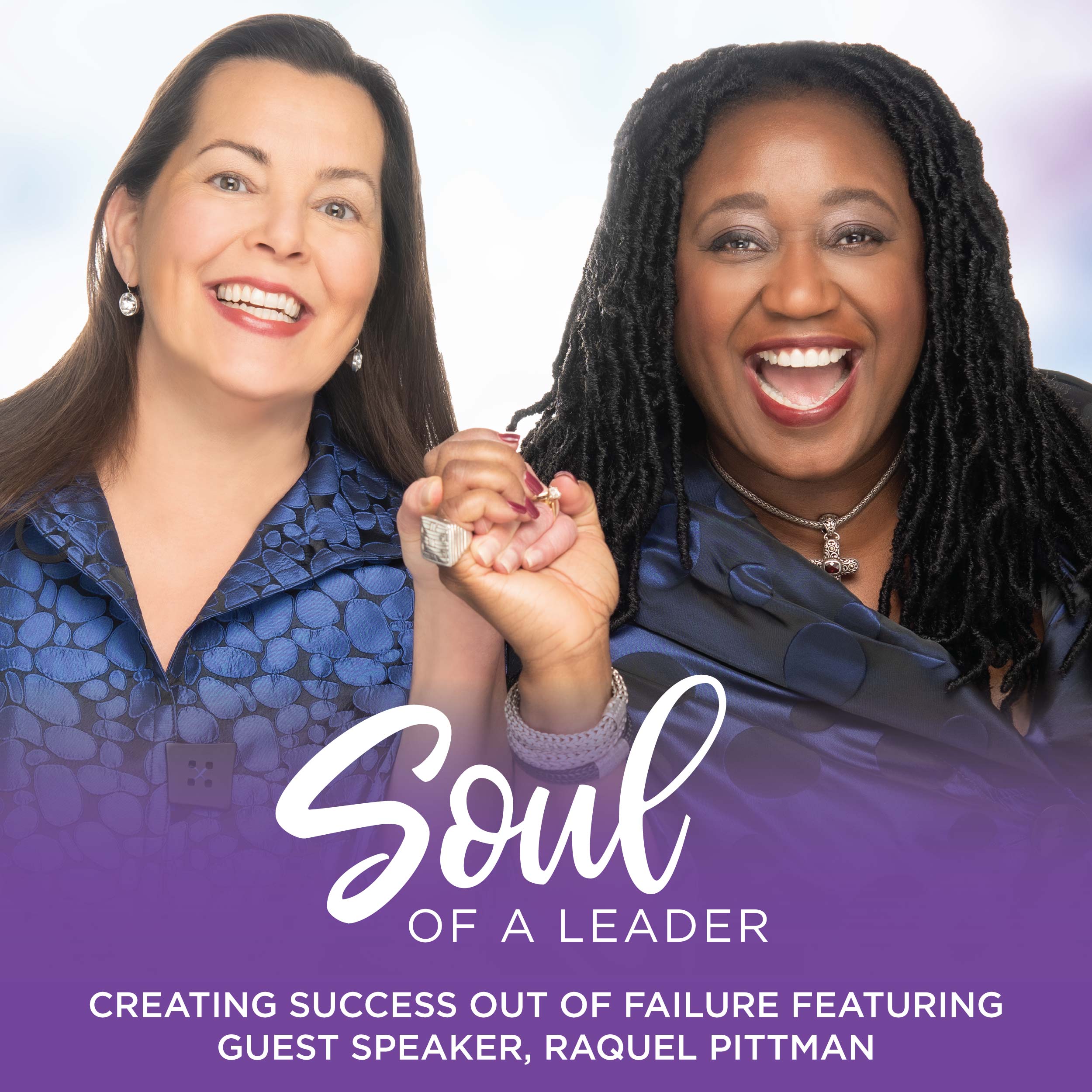
SOAL 01: Creating Success Out of Failure Featuring Guest Speaker, Raquel Pittman
subscribe
Our very first podcast guest, Raquel Pittman joins us and shares what leading with her soul looks like in her role as a Managing Director. Raquel loves helping grow small organizations but is not immune to the challenges that accompany this leadership position. Listen as she shares a unique situation where she felt as though she failed as a leader, and how this experience taught her how to successfully navigate problem-solving and conflict-resolution in the workplace. Sometimes it takes courage to develop into the great leader you were meant to be.
It does take courage to go back to the drawing board and try to figure it out. Don’t quit, don’t stop.
Understanding your actions after the fact and absorbing that and really getting into your heart and soul is self-awareness.
If your voice is suppressed and you’re in an organization, the employee nor the leader will be there much longer.
You need to be creative in how you problem solve, no matter what type of issue it is in leadership. Innovation is not just for product launches.
You’ll Learn
- Raquel Pittman has an MBA from Loyola University and has been in the business operations role as managing director for Peritius Consulting in Chicago, Illinois.
- Raquel experienced the most growth professionally while serving as a people manager. This position allowed her to become an authentic leader.
- When faced with obstacles with a team member in the workplace- open communication, face to face time, and self-awareness are the best tools.
- When in doubt, communicate to HR. Be objective. Take out emotion.
- Be creative in problem-solving, sometimes you will need to utilize critical thinking skills.
- You must be innovative when it comes to people issues.
Resources
Transcript
Narrator: Hello and welcome to Soul of the Leader podcast, where we make night soulful conversations with leaders. On today’s episode, Dr. Alicia and Dr. Eileen sit with Raquel Pittman to discuss creating success out of failure and understanding that leadership is all about growth.
Alicia: Welcome to Soul of a Leader podcast. We are so happy to have you in tuned in for our show today. We developed this podcast with the aim to ignite soulful conversation with our leaders. And one of our mission is to talk to ordinary people with extraordinary impact. We are excited. What about you, Eileen?
Eileen: Oh, hello. I’m Dr. Eileen Timmins, and I am excited to be here with Dr. Alicia. We feel that the flow of the soul is leading when followers and leaders both grow in contentment, spirituality, and other overall as individuals. We know that leaders can lead with their soul and values, and this compassion can bring personal experience that really amplifies a leader and executes on their vision. Plus, these leaders celebrate success on an individual level, but also share it as a team.
Alicia: Wow. You know what else we believe too on Soul of a Leader, is that in our profession, we know people have to lead with their head and their heart. Sometimes to deliver some meaningful and successful outcomes, we also understand at Soul of the Leaders that when you’re leading with your soul, there is a spiritual connection. There’s a sense of gratitude and responsibility. People who lead with their soul, we also believe there’s a vision and purpose and a mission behind their leadership ability. So with that, we were excited to discuss in more detail. We feel that everyone listening to our guest today will get something from how she leads with her soul.
Eileen: So today I’d like to welcome Raquel Pittman. Raquel has been in the business operations role as a managing director at Peritius Consulting here in Chicago. Peritius is a boutique management consulting firm focused on program and project management. They are program management generalists and they work with all types of initiatives, but mostly specialize in global programs for companies headquartered in Chicago area and beyond. In her role, Raquel is responsible for recruiting, personal development, program creation, and acts as a chief of staff to the CEO. She loves challenges of helping to grow small organizations and feel that talent management and retention is both one of the hardest yet rewarding areas in the leadership of business. Also, Raquel has an MBA from Loyola University and she’s a Loyola alum just like Dr. Alicia and Dr. Eileen. And we want-
Alicia: Yes. Loyola love.
Eileen: Go Ramblers.
Raquel: Yes, go Ramblers.
Eileen: We want to thank her for today for coming today to our studio for this wonderful podcast, our first episode.
Alicia: Welcome, Raquel. We are so excited to have you with us.
Raquel: So excited to be a pioneer, the first. How exciting.
Alicia: Very exciting.
Raquel: And pressure, but I’ll be great.
Alicia: We do know you will be great.
Eileen: Raquel, we’re here today as we talk to people who will be guests on our show, to share some inspirational stories around leading and in a way that has changed the vision of how you lead and how people follow you. So could you share with us today an example of leading with your soul?
Raquel: Yes, I can. Right now in my current role, I’m primarily administrative, but in my last position I was a people manager, and it’s really where I found the most growth professionally. The group that I led were pretty advanced. So, they were senior professionals. And I think my best example of where I had to lead with my soul was when, in an experience where I felt like I actually failed them as a leader. Managing senior people is tough because they don’t usually need a lot of guidance around their day-to-day performance. But it’s important I think in determining how you can be helpful to them to figure out how you can be an authentic leader to them. What do they need? What type of organization are you in? And in our organization, we were a start-up that moved to, were acquired by a larger company. It wasn’t huge, but it certainly had many more layers and quite frankly we felt that it had a lot more bureaucracy involved.
Raquel: So my role as a leader became someone who could work that bureaucracy for them. So as we merged the two companies, we acquired a team member who quite frankly wasn’t pulling her weight on the team. And it really had a demoralizing effect on a group of people that were used to working hard and long hours and didn’t need a huge amount of encouragement to do that. They had a really strong work ethic.
Eileen: Could you share some attributes that may have made this person not accepted into the group? And did it come around the bureaucracy?
Raquel: This person was, she was a little bit of a hot potato. So she had jumped from group to group to group. So my impression now is that she actually was in an organization that didn’t let people go frequently. She bounced around. So I imagine she was a little difficult. The group that I managed had kind of grown up together from entry level to senior people. So they were used to, I guess they were bought into … There was a little bit of the, we manage the engine of the company. So there was a little bit of pride in the fact that we had developed that engine together. So we all understood the ins and outs. The person that we acquired from the acquiring company, she was a bit on the outside of that. And I would say there was no pride in being made here and she didn’t share that same perspective.
Raquel: So she didn’t necessarily follow the same policies we had around … We worked in a data environment, so around keeping data private, around some of the formalities we took around data and working with our customers. She didn’t necessarily work on, and quite frankly, didn’t follow those policies and was very flagrant in her, “I’m not going to do that. I don’t have to do that.” I think the team members couldn’t really understand why she couldn’t follow quote unquote follow a rule, and it really felt like it was a, you can’t tell me what to do mentality, which they just weren’t used to. So it felt really disrespectful and she wasn’t working as hard, not only in the same manner but not working as hard. It was the way it was perceived, I guess.
Alicia: So how would you see yourself as looking at this situation as a challenge? What would be the first alternative what you would have done with this individual that you already knew had to, really was a problem, really bounced around, really disrespected some of the core values for leadership of that organization?
Raquel: I guess if I could go back in time, I would reach out to my HR executive to find out what I could do. What leeway do I have? Do we have a situation where I put her on a performance warning? What is the process around correcting behavior? And then sit down with her really frankly and share some of the concerns of the team. I think some of my reticence at the time was I didn’t want her to feel as if I had already accepted that these things were happening and that she wasn’t given an opportunity to give her side. And I probably would have spent a little more time with her, like that creating my own relationship with her. Since I didn’t choose her, I really didn’t have a good conduit to really have an open communication with her.
Eileen: And so how were the team dynamics there? Can you tell us what happened when she joined the team and what was your leadership? What are some of the attributes you used to make her belong or have the team embrace her? If you could share a little bit about that.
Raquel: Yeah. Well she was a bit of an outsider, to be frank. She came from the acquiring company. So we brought her in to be, to visit, to sit with us. Her training was done face-to-face. We made sure she came in frequently for team meetings. So to try to create an opportunity to bond and be a member of the team. I really do believe the team was open. She didn’t have a quote unquote reputation, so it was greenfield when she came in. We were certainly assumed that this would be appropriate. So it was a bit of a surprise when three or four months in I found out that it wasn’t working out that way. So we tried to get as much face-to-face as we could. We tried to have as much remote training as we could, and I certainly went out to meet with her immediately actually when she was first brought on the team. I went out to meet with her face-to-face.
Eileen: And how did you find out about some of this behavior? Was it by a 360 review? Was it customers? Was it her peers? Was it other departments? And as a leader, how did you assimilate that data to create action?
Raquel: Well, that was probably one of my first mistakes. Her peers took me in a room … and just a little backstory. These were my peers. So I was promoted to manage this group, and that went well, which doesn’t always happen. Well, there was one problem, but overall they were happy to report to me. So we had a really strong relationship. So two representatives were chosen to sit me down in a room and really talk to me about what’s going on. And the quotes they were giving me didn’t even feel professional. This felt like a child. Like you can’t tell me what to do and I’m going to do this, and so what? And we had weekly meetings and so I didn’t even feel like I knew the person that they were describing. That’s how different the behavior was. So, I got this information from her teammates.
Eileen: And what courage did that take from the teammates to come to a leader who they trusted to act on this.
Raquel: Yes. All the more while I was frustrated when I couldn’t do anything. And that was how I really evaluated myself. Like this is my utility to this team. I break down walls, I describe policy. I have difficult conversations so they won’t have to. I was out in front. Right? So they sit me down in a room and they’re saying this is what’s going on and it’s horrible. They were professionally outraged that this was happening. And I was like, “Yeah, I’m on it. I got this. That’s horrible.” So, I walked myself right into HR and said, “Can you believe this? What should we do? Just give me the weapons to fight this.”
Raquel: And just all the air was sucked out of me when it was, “So they just said this? That’s all you got? You have their word? That’s really not going to work.” I was like, “Wait, what? Do you know these people?” So the trust I had in my team members, team mates, because we were all, in our roles, we all agreed upon, we all had this credibility with each other. So there was no question in my mind. So, another mistake I probably made was when they shared this information, I probably should have been a little more objective in receiving these quote unquote facts.
Alicia: Open to receive it, yes.
Raquel: Right? So just well, and probably focus on behaviors other than their feelings because they were so upset. I just grabbed that, and I was immediately upset.
Alicia: So Raquel, would you think it had a lot to do with your ability as a leader with a sense of integrity, that respect level, and also really learn it? Because you have to learn people that you lead. You mentioned that she was a person from the outside. Well, you knew the people on the inside of your core group. So would you think there was a sense of your integrity and that learning part as a leader, that you had to really dive on the inside of yourself to figure out what to do best?
Raquel: Yeah, I think that that’s probably the first place you should start is really just trying to understand where your heart is.
Eileen: Raquel, was it self-awareness after the fact of learning all of this? There’s a great book called Leadership and Self-Awareness. And understanding your actions after the fact and absorbing that and really getting into your heart and soul is self-awareness.
Raquel: Yes. And that really became important in understanding what the lesson was. Because previously, if I talked about this experience before, it was about how HR was unresponsive. I had an issue and HR didn’t address it. But in my current role, I work with really senior project leaders who are asked to solve really tough issues. And it’s not about the tools of project management, it’s about the people issues. It’s delivering things in tough environments or delivering something across different cultures. So you really have to think outside of the box and really try to understand where you are and what it is you can do in that environment. And if I take that approach to looking at my options in that scenario, then I put the responsibility on me. I become accountable for the results and I really try to work through the environment I was in.
Raquel: The two, the organization that merged with another, one’s outside. We’re all kind of still pitting ourselves against each other. And try to work within the team more. Probably communicate to HR more the impact to the team as opposed to the feelings that were floating around. That probably felt a lot like, “Oh my goodness, Chicago is whining again.” And really try to work through a solution as opposed to trying to make people feel better. Keep it more objective on those data points. I probably could’ve been a lot more successful, even if the policy is, it’s hearsay, we can’t do anything. I probably would have figured something out.
Alicia: Yeah, because Dr. Eileen and myself are HR professionals, so we really don’t like to hear the words that you went to HR and don’t get any outcome out of that. But what I hear from you is a lot of inner strength. Looking at your sense of power, looking at the situation in a different way, thinking outside the box, which is one of the words that I heard you say. Would you say going forward you would take that approach to that inner strength and that power that you have and look at how you can make some impact?
Raquel: Definitely. I think that when you are feeling constrained by your environment policy, fill in the blank, that’s probably, and this is what I … If people come to me with issues they’re having where they’re not in control of the variables, that’s where I ask them to start. And so I think starting with, okay, what can you control? What do you own? And the fact in that scenario, I had good relationships with my team members, I do believe that HR would have been open if I’d taken a different approach. They would have listened if I had switched gears and not been so offended. And I think I had the quote unquote power in the environment. I was a strong performer. I think I had the credibility there that I could’ve probably initiated something that was not outside of the bounds of the policy and probably helped.
Eileen: Well, and when I hear you say that you’re looking back, it was, as I always say, every situation, every interaction can either be a lesson or a blessing. And I think what I heard you say is that you learned from this, you went deep into your soul, you did some summaries and you executed. And you talked about the fact that you had to use tangible evidence. But also there’s people and the people’s feelings and tangible evidence, and meshing those together for a solution. Because everybody who we work with anywhere has their own perception and their own filters. And it’s how I heard as a leader, you took that and you cleared it and then you went and reset. Now how did that feel when you did that?
Raquel: Well, at the time, I didn’t know that I did do that. It’s really more in retrospect that I can reset and use this lesson, make it a blessing really and really use that to kind of fuel my additional, as I work with people in the future. At the time I think I was too subjective. I was very, like I said, these were my teammates, and so I really bought in. I’m not even going to use the word bought in. I just knew they were telling … that their relating of the facts were the facts. How they perceived it was exactly what happened. So, what I should have done is step back, looked at those data points, figured out a business case that my HR executive could have grabbed onto and resolved, and cleared it like you just described. And really just said, “Okay, so let me take out this emotion and talk to you about the productivity of my team,” versus there’s someone that’s not pulling their weight and they’re really pissed. Can you help me? Well no, I can’t help you with that.
Raquel: And it’s, yeah, she could have responded differently. She could have been more probing, but in the absence of that, and the things that you can’t control, you really have to think about how you present issues, especially issues that are, I guess I would say with hearsay and how people perceive other people’s actions. If you’re going to escalate it, you probably need to focus on impacts and actual facts and data and behavior versus feelings. It’s very difficult to do anything about how people feel.
Eileen: Yeah, and as a leader you have to not only hear the feelings, but you have to give the chance to have somebody voice their concern. Because if your voice is suppressed and you’re in an organization, the employee or the leader will be there much longer.
Raquel: Yeah. Yes, that’s true.
Alicia: I have one question to ask you, Raquel. When you look at everything that you had to deal with, what is one word that you can sum up as a gratitude for this situation?
Raquel: I guess I would say innovation maybe. Innovation in terms of problem solving. Being able to sit back and understand that the no is not the end and understanding that you need to take a different path. You need to be creative in how you solve no matter what type of issue it is in leadership. Innovation is not just for product launches.
Alicia: Absolutely.
Eileen: It’s for people, too.
Alicia: It’s for people.
Eileen: People issues, you have to be innovative.
Alicia: Absolutely.
Eileen: Creative. Use your decision making, your critical thinking skills. That’s all I heard.
Alicia: Yes. And a sense of courage too because you have to have enough courage to want to make a decision to do something different.
Raquel: Yeah. I think that when you get a policy or someone … When your senior leadership or whatever the escalation process is, when you hit a wall, it’s very easy to say, “Well that’s it.” It’s very easy to say that’s it and that’s a wall. It does take courage to go back to the drawing board and try to figure out, don’t quit, don’t stop. Try to figure out a way to solve that problem. If it’s bothering you, if it’s sitting in your soul, your heart’s not in line with your actions, that’s probably an internal sign that you need to revisit. You need to, don’t quit. Just be persistent. Be more persistent in solving the problem, especially if it’s around people you’re supporting as a leader. They need to see you struggle. I don’t think there’s anything wrong with being authentic and I’m still working through this. I’ve hit a road bump, but I’m working through it. And just work, I guess. Use your innovation. Use creativity. Try to figure out some way to alleviate some of the discomfort I think.
Alicia: I like that word, see you struggle or that phrase, see you struggle. I think oftentimes people see leaders and think that it’s easy, but you hit it on the nail. People have to see that you’re working through situations and whenever you’re leading with your soul and your heart, it’s in it. There are times that it gets rough as a leader. There’s times that you have to use your wisdom in passionate leading with people. And I think you did a very good job explaining to our audience some of your lived experiences in your stories that are really, really close to your heart that has helped you develop as the great leader that you are, Raquel. So we certainly appreciate you being here with us on Soul of a Leader.
Raquel: Thank you, Dr. Alicia, and thank you for those kind words.
Eileen: So thank you so much, Raquel, for being part of this first episode of the podcast. We cannot thank you for your words of wisdom, your guidance, and it will help our listeners. So if you’d like to learn more about Raquel, please go to Peritius.com or you can connect with Raquel on LinkedIn and her, Raquel Pittman in the Chicago-land area. Thank you so much, Raquel.
Raquel: You’re welcome, ladies.
Alicia: Thank you for listening to Soul of a Leader. We are igniting a new way of leading with your soul on the Soul of a Leader podcast. We are interviewing ordinary people with extraordinary impact. Thank you for joining us and listening to the stories of our soul for leaders to help you think about the process of your leadership journey. Thank you for listening.

With Dr. Eileen & Dr. Alicia
Conversations grounded in spiritual, authentic, and servant leadership.